Deacon Job Lane and the Church in Bedford: Loyalty and Leadership in a Time of Change
Job Lane Farm Museum Annual Meeting | March 29, 2026 | Sarah Castricum, PhD
Our whole world of thinking has changed so much over three hundred years, and I want to talk with you today about some of those changes, to try to get a bit closer to how Deacon Job Lane and his people would have thought about their own lives, especially life in the church which was central to them. After all, they were like us in the most important things that make us human, sometimes looking for meaning in the ongoing work of everyday life, and sometimes navigating big shifts like the religious and cultural changes rocking the New England colonies in the mid eighteenth century. What challenges were they facing, how did they manage them, and is there any way their work and witness can speak to us in our changing times?
Anyone who has explored Bedford history will hear the debt I owe to the historians who have gathered it for us, among them Abraham Brown a century ago, Louise Brown much more recently, Ina Mansur with her indepth work in A New England Church and brief biographies of the early Lanes, and most significantly Sharon McDonald who for many of us has made the wealth of Bedford history our own legacy as a town. The Bedford Historical Society has curated thousands of artefacts. Among the resources it has made available online is a collection of Lane Family papers which give us the chance to glimpse Deacon Job Lane and others through his will, and other correspondence about legal matters and life events. The archives of First Church and First Parish hold copies of their records going back to the founding, and the Internet Archive has a digitized version of Bedford town records.
Town records tend to follow set patterns, telling us when meetings happened, what was voted on and the outcome of a vote, who was appointed to a role or commissioned for a task and, of course, what money was spent. One decision that comes up annually in this community where almost everyone is farming is whether to let “the swine run at large” so everyone’s pigs were allowed to forage freely and from what I could see they always were. What we have from this bare outline of town life makes me think of an image from weaving: we have the steady warp of church and civic structures doing their faithful work and recording the essentials, year in and and year out, and we have a weft of wider world happenings, events that impacted the colony or cultural trends that would have also have filled people’s thinking and emotions. I’m hoping we can think a bit today about how it all comes together in lived experience.
I’ll start with a brief outline of Job Lane’s story as it fits into Bedford’s origins, then take a step back and consider what that local history means if we look through the wider lens of their colonial New England setting and its evolving, vibrant Puritan spirituality (four words you rarely hear spoken together, folks). I want before going any further to acknowledge a tension here: Job Lane and his people claimed their religion and way of life as the way, and it’s hard to talk about their context without edging out other faith perspectives, which did exist, let alone indigenous and African perspectives. I’ll offer some reflections on those gaps toward the end but just want to recognize them at the outset.
The first question to answer, of course, is which Job Lane am I talking about? The subject of our talk is the Job Lane who was born in 1689 in Billerica, who became one of the founders of this town and originating members of its church, who built the house which is now the center of the Job Lane Farm Museum, and who died in 1762 in Bedford. Because he served as a deacon for the last 20 years of his life, we often call him Deacon Job Lane and that title is a helpful marker because he stands in the middle of an eminent line where that name recurs (see the first section of your handout). He was the son of Susanna and Major John Lane, an important figure in the mounted militia in Billerica, and grandson of Hannah and Job Lane who emigrated from England and eventually settled in south Billerica and created a farm which Deacon Job eventually inherited and which marks the beginning of European settlement in what is now Bedford. That’s how the tree reaches back. As it reaches forward, our Job Lane had a son also named Job who joined the call to go to Concord on April 19, 1775 and was wounded in action.
Job Lane, eventual deacon, must have distinguished himself early on as someone others could depend on for sound judgment and fairness as well as reliable hard work. And maybe we have more in common with our Puritan predecessors than first meets the eye – being successful means being on lots of committees and wearing lots of hats – and the next section on your handout lists some of the roles he was asked to take on. His first appointment was as a tithingman, someone responsible for making sure people stayed awake in church and paying the offering they owed. He served on the committee to find a location for the school in South Billerica, was elected selectman, and at age 35 appointed Lieutenant in the provincial troops by the governor. In 1713 he married Martha Ruggles, the sister of his minister, and together Job and Martha had eleven children of whom three daughters and three sons lived into full adulthood, a common record of loss for the time, harder for many of us to imagine now.
Attending church was a requirement for life in a New England town, and both Billerica and Concord covered a lot of geography and were growing in the early eighteenth century, so a critical mass of people was starting to feel the burden of long trips to church in the centers of their respective towns on Sunday morning. Now in the 21st century we only have bad snowstorms on Sunday night into Monday morning, but back then they might have had snowstorms throughout the week, including on Sunday morning, so that could have been a real problem. By the later 1720s there was a movement among citizens in south Billerica and east Concord to pull away and form their own town, and in 1729 they succeeded in founding Bedford.
Job Lane was one of about a dozen who contributed to the treasury to get it started while six others gave land. He was also one of the founding members of the church, and one of a committee of two appointed to recruit the first minister, organizing a day of prayer and fasting as part of the discernment process. They called Nicholas Bowes, known to Job Lane as a school teacher in Billerica, so his role in the proceedings must have been pretty significant. The first deacons appointed were Israel Putnam, originally from Billerica and Samuel Merriam, originally from Concord, and when Merriam died in 1738, Job Lane was appointed in his place. So he and Israel Putnam were in that role when Bowes resigned, and Job Lane was also part of the group which formally welcomed a new minister, Nathaniel Sherman.
In the meantime, to fill out our thumbnail biography, Job Lane was even more active in Bedford town life than he had been in Billerica. In the first meeting to select town officers he was chosen as surveyor, and over the decades that followed he went on to be assessor, treasurer, selectman, at least four times moderator, and as in Billerica, responsible for finding a location for a school and providing a teacher. Some commissions were adhoc, as when he was asked to represent Bedford in court cases. Along with John Fassett and Jonathan Bacon he was asked to establish the boundary with Billerica, and in the years that followed to review and maintain it, which involved walking along it and adding or replacing markings, the letters BB for both towns. Here’s the line, as it was recorded in April 1735:
>>Beginning at a black oak tree with stones about it in Woburn line, running westwardly to a white oak tree marked BB from thence to a pine tree marked BB from then to a stake and stones in Tomsons line, then running upon Tomsons line to a hepe of stones which is Stephen Richardson’s corner then turning and running in a straight line to a white oak tree marked WFBB then running westwardly in a straight line to Bacon’s northwest corner which is a rock and stones then running in a straight line to Paige’s northeast corner to a walnut tree and stones then running to Paige’s norwest corner to a mapel stub and stones about it then running in a straight line to Matthew Whipple’s norwest corner to a white oak tree marked BB which tree stands by Concord River.<< That must have taken some time to walk.
This listing of roles testifies to an impressive life, by any measure. We can see it even more fully when we consider it in light of the religious culture of Puritan New England. It was in terms of this setting, with its intertwined civic and church structures, where faith was lived in community as much as within individuals, that Job Lane and his Bedford contemporaries understood the meaning of their lives and their work.
In terms of structures, let’s start with the Massachusetts Bay Colony which began in 1630 with a charter that allowed it to be governed not from England, but by authorities within the colony itself. The Colony was a commercial interest, but many of the people who came from England to settle it were Puritans, who stepped out of the mainstream of English parish life wanting to live and worship in ways more closely aligned with Christian scripture. So they had experience and practice in creating their own communal structures and fostering leadership, and as the colony expanded, towns like Concord and Billerica were established with their own meetings and officers as well as strong ties to each other for mutual aid. There’s a wonderful phrase that appears sometimes in the records of a meeting when the purpose was to make a decision about something; they gather to “know the minds of the town” about it. Given this history, it makes sense that although the church exists as a separate institution from town, the governance of both are intertwined; Job Lane’s first appointment as a tithing man was a town office, not a role in the church, and the town was required to make provision for a church as well as the payment for a minister.
The church also had offices in its own right, and we learn about them from the Cambridge Platform, a declaration of principles adopted a couple decades after the founding of the colony to codify church practice. It provides for a number of roles, although Bedford seems only to have had two of them: pastor (who had the primary role of preaching and administering sacraments of baptism and communion) and deacon, in Bedford’s case two at a time. We know from the Platform the kind of thing Job Lane would have been responsible for: to receive offerings and gifts given to the church and manage the finances, and “to serve the tables,” providing bread and wine for communion and food for “such as are in necessity.” The description of deacons is different even from that of pastors in specifying not just tasks but personal character (“Grave, not double-tongued, not given to much wine, not given to filthy lucre”) – something which for sure holds true to this day.
From the earlier glimpse into Job Lane’s life, we can see some of the ways civic functions and the role of Deacon dovetail perfectly, and other things that might not be related to any role but are of a piece with this sense of service. He was appointed to be the guardian of a widow, Rebekah French, who seemed to be facing some legal or financial complications over several years since he not only made provisions for her, he went to court when her case was being heard. That’s one of the moments when we would love to know more than the documents tell us. We also have the record from 1756 of a five year indenture arrangement he made to take in an orphan, apprentice him to animal husbandry and teach him to read, write and do math. In return the servant also makes a number of promises, including not to “haunt alehouses, taverns or play-houses.” The boy in question was another John Fassett, from Lexington rather than Bedford, but of course we can’t help wondering if this is someone related to Job Lane’s friend from his earlier work on town boundaries.
What connected individual members in a church community and made them a congregation was taking a covenant, a sacred promise to each other as well as to God and a declaration of belief. In the covenant signed by the founders of the church in Bedford, including Job Lane, they promise to be accountable to each other and help each other as members of one body, and to provide for the offices and work of the church itself, and mutual aid for other congregations in the wider church. Letters and diaries written by both women and men from this period show us how much comfort in sorrow and joy in all times came from conversations and correspondence between friends who shared faith. Thinking of the lists from town meetings, with citizens shouldering the work of their community side by side down the years, and John Fassett, Jonathan Bacon and Job Lane walking the boundary with Billerica together, I wonder if we’re glimpsing friendships that stood the test of time and got people through terrible losses and moments of uncertainty.
What might come as a surprise given how we usually think about the Puritans, is that not everyone in any town would have been a member of the congregation. Although everyone was required to attend, membership involved another level of commitment. One was required to make a public confession in front of other church members, where one would name one’s sins and give a testimony of repentance. The congregation would then judge the authenticity of the confession. At some point Job Lane would have done this to join the church in Billerica. The Cambridge Platform encourages compassion and gentleness, accepting “the weakest measure of faith,” and Bedford opted as many churches did to forgo the vote of congregational approval after a confession. In any case, less than half the people in most congregations went through it, especially as time went on and the generations who populated the towns and churches were there by birth rather than by choice. Bedford was one of many congregations that followed a practice of allowing people who weren’t full members to have their children baptized in what we’ve since come to refer to as a “half-way covenant.”
Confession was not necessarily a single event done only when joining; if a church member later committed a significant sin, they would need to confess again and be forgiven. This was surprisingly common, and people confessed everything from staying away from church, to fornication, to dishonesty in financial dealings. Sometimes the layperson would make the confession first to the minister, who would then read it as a written statement in front of the congregation. What’s interesting is that often the laypeople are often hardest on themselves, and we have some sermons where ministers are urging people to be more trusting in God’s grace, or to put it theologically, to lighten up.
This practical compromise came under threat in the 1740s because of a movement called the Great Awakening, which swept through the colonies and impacted the Bedford church as it did communities all over New England. The movement was sparked by an itinerant evangelical preacher named George Whitefield who emphasized heartfelt conviction of personal sinfulness, fear of damnation and direct experience of salvation through Christ. Laypeople inspired by him and other “New Light” preachers who followed in his footsteps, came to regard this sort of experience and ongoing emotionally engaged devotion as the only way to be Christian. Many of them either left the congregations they had been part of and formed new ones, or pressured their ministers to invite evangelical preachers into their churches.
The congregation in Bedford was rocked by this same conflict, as Nicholas Bowes stood shoulder to shoulder with other clergy who refused Whitefield entry into their communities. As Charles Chauncy, a friend of Bowes and a leader among the more traditional clergy put it, “People have been too much applied to, as though the Preacher rather aimed at putting their Passions into a Ferment than filling them with such a reasonable Solicitude, as is the Effect of a just Exhibition of the Truths of GOD to the Understanding.” For a while the Bedford congregation followed their pastor but pressure was building from followers of the “new lights.” In 1753 the congregation excluded Bowes from the pulpit, although he was retained by the town as a teacher, and Nathaniel Sherman, the new minister they called in 1755, was decidedly a New Light. Sherman eventually put an end to the practice of baptizing children of those who weren’t full members, but the congregation in Bedford was already beginning to think differently and he was dismissed soon after. By that point Job Lane had been dead three years.
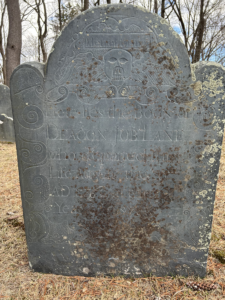
We know very little about the character Job Lane’s personal faith, and how he felt about the New Lights. He clearly owned a Bible, since he bequeathed it in his will. He was among the group that signed the receipt of Nicholas Bowes’s resignation, and when the time came he helped make settlement arrangements for the new pastor, but he was not on the committee that recruited him. Was Job Lane going along with the mind of the town, the consensus of the faithful, to keep his community from splitting apart? One of the simplest, humblest indications of his faith might be his tombstone. Others from the same time period, including his own brother, have language that evokes the spirit of the New Lights: While I lye buried deep in dust my flesh shall be thy care; these withering limbs with the I trust to raise them strong and fair.” Deacon Job Lane’s marker uses the humble, more traditional convention of sticking with the facts: name, date and age.
The Great Awakening conflict is a good reminder in any case of the driving aspirations that brought Puritans to New England in the first place. It’s easy now to be cynical about the blending of commercial and religious interests by people who came to do good and did very well, so maybe there’s something to be said here for distinguishing intent from impact. In a famous sermon preached just before they left England, John Winthrop who would later become governor in Massachusetts and the grandfather of the FitzJohn Winthrop who in 1664 sold emigrant Job Lane the land in Billerica which first brought the family to the area, exhorted the Puritans he was leading to partake of each other’s strength and infirmity, weal and woe, and to make “care of the public” “oversway all private respects.” This is the same sermon that gives us the visionary line about how the colony would become “a city upon a hill,” an ideal community shining light into a dark world. This was the guiding vision for many seventeenth and eighteenth century settlers. And perhaps for someone like Job Lane, important aspects of service to the town might have been spiritual as much as practical.
In terms of impact, the colonies displaced numerous indigenous peoples and destroyed both individuals and ways of life. This staggering gap is partly explained, never excused, by the doctrine of discovery, a theory put forward in a Papal Bull of 1493 that any land not inhabited by Christians could be taken over by them with the goal of spreading Christianity and bringing all other people to its faith. Now, what had happened the year before 1493? Clearly this doctrine was a convenient way to justify the conquest of lands recently discovered by Europeans to be holding a lot of wealth. This was also a couple of generations before the Reformation really got underway, so by the time Puritan English settlers were voyaging to the new world it had thoroughly saturated their thinking as well.
My bibliography includes a link to Sharon MacDonald’s talk outlining what we know of indigenous life before the arrival of Europeans in this area, which we can’t associate conclusively with one nation although we know from the trails which later became our main roads that it was traversed by many. The militia in which Deacon Job Lane’s father was an officer fought in skirmishes with forces gathered by Metacom in King Philip’s war, and twenty years later, early in Job’s childhood, there was another series of attacks. The Pawtucket peoples, who may have been closest to Bedford, stayed neutral in the conflict and many settled in “praying villages” where they converted to Christianity and gave up their own culture and language. By Job’s adulthood even they had left for Canada, saying it was no longer safe to remain in the area.
Job Lane did live through the time when enslaving Africans was legal in Massachusetts, and we have a record of his father purchasing and enslaving a man named Tony when Job himself was only two years old, so he would probably have grown up with a close awareness of human enslavement. We don’t have evidence that Job Lane himself enslaved anyone, although he would have been wealthy enough to do so, but Nicholas Bowes apparently did, as First Parish has publicly acknowledged. Most of the people speaking out against slavery at the time were Quakers, but the idea of abolition was out there. We’re still coming to terms with these dark legacies, and what our response should be as the people who now live on this land, especially those of us who have in some form inherited the wealth generated by enslaved people. I don’t want to minimize these questions, but I’ll leave them for another day.
We can’t fault the records that have survived to us for what they fail to show, but obviously there are some questions I would love to ask Job Lane directly if I could get into a proverbial time machine and go back and meet him. Assuming he did make a confession of faith to his congregation to become a full member, what did he say to them? (If that’s not too personal). What happened with Nicholas Bowes, and how did Job Lane really feel about the direction the church took during the Great Awakening? Of all that he did, what gave him the most pride?
Some parting reflections:
Puritan culture did not welcome differences in thinking and ways of life; the point of their life in America was to pursue a way they discerned was right. But within their sphere, they could be deliberate and thoughtful about their decisions, hearing the minds of the town and taking time for prayer as their best resource, especially on important matters. With the work he undertook to help at least some vulnerable members of his community we sense that Job Lane was compassionate with his fellow humans. For Puritans, beliefs were communal as much as they were individual; their faith bound them to each other as much as to a creed. Whatever Job Lane’s understanding of faith, he might have seen the need to follow the discernment of the congregation when it came to welcoming Nathaniel Sherman as the second minister.
It’s hard for us to imagine what it would have been like for them, living as closely in every way as they had to with each other, so there might have benefits to them that are less obvious to us than the downsides. They could be both exacting in holding each other accountable, and realistic and understanding with each other. And while I wouldn’t want to trade our assumptions about privacy let alone modern plumbing for the communal life they had, it did include a powerful understanding of the common good, collective responsibility to care for each other and the role of civic institutions in making that happen. From what we can see in the weft and warp of early Bedford life, Job Lane embodied the best of it. What would you ask Deacon Job Lane if you could meet him?